

Moving company lead generation works when you stop paying for leads and start measuring booked moves. HiCloud Media runs paid search, call-focused landing pages and call tracking for movers, and reports on cost per booked move. For Whitaker Family Movers, that went from $312 to $189 between October 2025 and March 2026.
We’ll look at your current lead sources and what each one costs per booked move.
Why most moving leads don’t turn into moves
Most moving leads fail before anyone on your team picks up the phone. The lead was sold to three other companies, the customer only needed a truck for a Saturday, or nobody can say which ad produced it.
Start with shared leads. A shared lead goes to several movers at the same moment, so the first company to call usually gets the conversation, and the conversation usually turns into a price fight. That’s the model working as designed. One lead vendor, MoveLead, publishes its prices openly: a shared local lead sent to up to four movers is $15, and an exclusive local lead is $45. Its exclusive long-distance lead is listed at $85 on the same page.
Then there’s mismatch. If your margin lives in interstate and long-distance work, every local one-day inquiry costs your office time and returns very little. Generic search terms and broad lead forms pull in exactly those inquiries.
Finally, reporting. Most reports stop at form fills, which tells you how many people typed their name, not how many trucks went out.
Those $15 and $45 prices look like the whole decision. They aren’t. Price per lead is the number on the invoice. Cost per booked move is the number that pays your crews.
Cost per booked move is the number that matters
Cost per booked move is your total lead spend divided by the number of moves that actually booked from those leads. Put another way, it’s your cost per lead divided by your close rate.

Here’s an example with round numbers, for illustration only. Say a mover spends $4,000 in a month on one lead source and gets 100 leads at $40 each. Ten of them book. That’s $400 per booked move. A second source charges $80 per lead, sends 50 leads for the same $4,000, and 20 of them book. That’s $200 per booked move. The lead that costs twice as much books moves at half the price.
You can only run that math if your reports end at the move, not the form. That’s why, for Whitaker Family Movers, we “tied monthly reports to confirmed move dates instead of form fills.” Once every lead is traced to a booked job (or to nothing), budget decisions stop being guesses.
How HiCloud runs lead generation for movers
A lot of agency work for movers still gets judged on traffic and lead counts. We build lead generation for moving companies around a narrower question: which inquiries become profitable moves? Everything below serves that.

Paid search built around the moves you want
Local moves and long-distance moves are different businesses, so we run them as different campaigns. That means separate keywords, separate ad groups and separate budgets, so a cheap local click can’t quietly eat the money meant for interstate jobs.
Imagine an interstate mover whose search campaign bids on generic “movers” terms. The pipeline fills with one-day local jobs, the phones stay busy, and the long-haul calendar stays thin. Google Ads for moving companies should do the opposite: when long-distance work is the profit center, budget moves toward interstate and long-distance intent first. That’s the shift we made for Whitaker Family Movers.
Landing pages per move type
A residential long-distance customer and an office manager planning a commercial relocation want different answers, so they get different pages. For Whitaker, we “created separate landing pages for residential long-distance vs. commercial moves.”
Each page carries one offer and a short form. A click-to-call button sits where a phone user’s thumb already is. A couple of qualifying questions (move type, approximate date, origin and destination) help your team sort inquiries before the first call. See our services.
We explain when a landing page is the right destination for an ad, rather than the homepage.
Calls first, then forms
A caller who already has a move date is usually worth more than a stack of form fills. Phone inquiries tend to come from people further along: they’ve picked a week, they’re comparing a short list, and they want an answer now. Form fills include those people too, but also the ones collecting quotes for a move that may never happen.
So we design ads and pages to make calling the easy option, and we keep the form for people who can’t talk right now. See our services.
Call tracking, recording review and basic scoring
Every campaign gets its own tracked number, so each call traces back to its source. Then we listen. Recording review shows whether a campaign is producing real long-distance inquiries or price checks for a local job. For Whitaker, we “added call recording review plus basic scoring so sales could prioritize better inquiries.”
Scoring doesn’t need to be complicated. A simple grade (booked, qualified, not a fit) gives your office a call-back order and gives us a cleaner signal for where the budget should go. See our services.
Paid social where it fits
Meta ads have a place in a mover’s mix, just not for the customer who needs a truck tomorrow. They’re useful for retargeting people who visited your site and left, and for planned moves where the decision takes weeks. We keep paid social secondary to search for most movers and judge it the same way: on booked moves, not clicks.
Case study: Whitaker Family Movers
Whitaker Family Movers works Midwest to Southeast routes. Paid search was generating volume, but a large share of inquiries were local-only or pure price shoppers, and the cost of each real long-haul booking kept climbing.
What we did:
- Moved budget toward interstate and long-distance intent keywords
- Added call recording review with basic scoring, so sales could call the better inquiries first
- Built separate landing pages for residential long-distance and commercial moves
- Tied monthly reports to confirmed move dates instead of form fills
Results, October 2025 to March 2026:
- Cost per booked move: $312 to $189
- Qualified long-distance inquiries per week: 6–8 to 14–17
“We finally stopped paying for people who only wanted a local truck for one day.”
Whitaker Family Movers
Moving is one of the verticals we know best. Our About page lists “10,000+ moving leads generated.”
Buying leads vs owning your lead flow
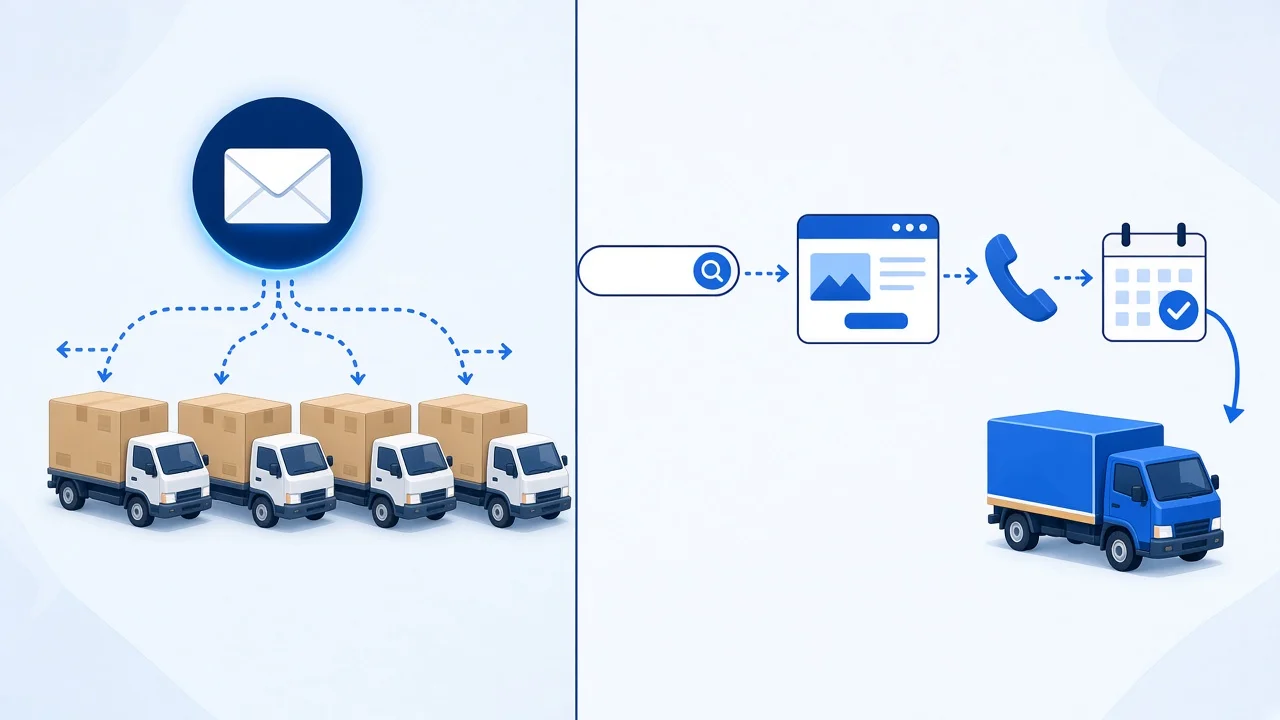
Buying leads and running your own campaigns answer different problems. Here’s how the three common options compare.
| Comparison point | Shared leads | Exclusive leads | Your own campaigns |
|---|---|---|---|
| Who else gets the lead | Several other movers (up to four on MoveLead’s shared tier) | Nobody, from that vendor | Nobody |
| What you control | Price tier and service area | Price tier and service area | Keywords, move type, ad copy, landing page, budget |
| What you can measure | Leads received and booked | Leads received and booked | Every step: click, call, form, booked move, cost per booked move |
| Where the demand lives | With the vendor | With the vendor | In your accounts, for as long as you run them |
For a closer look at the first two options, see our guide to how exclusive leads differ from shared ones.
Our view: an aggregator can be a reasonable stopgap when you’re opening a new route and need calls this week. But it’s rented demand. The day you stop paying, the leads stop, and you’ve learned little about what your customers searched for. Your own exclusive moving leads, from your own campaigns, build an account history you keep. That matters most for long distance moving leads, where each job is worth more and every rented lead is one a competitor may also be calling.
For the side-by-side math, see our guide to buying qualified calls versus running your own paid search.
What to fix before spending more
Before you raise any budget, check these five things.
- Speed to lead. The Lead Response Management study found “a staggering 21-fold decrease in the odds of qualifying a prospect if the response time stretched from 5 to 30 minutes.” If inquiries wait until the next morning, fix that first.
- Separate local and long-distance. Different keywords, budgets and reports. Otherwise you can’t tell which side is paying for the other.
- Call tracking on every number. Every ad, every page and every listing you pay for needs its own tracked line.
- Booked-move reporting. If the report ends at form fills, nobody knows what’s working.
- A landing page per move type. Residential long-distance and commercial customers shouldn’t land on the same generic page.
FAQ
How much do moving leads cost?
It depends on the vendor and the lead type. MoveLead, one lead vendor, publishes $15 for a shared local lead sent to up to four movers, $45 for an exclusive local lead and $85 for an exclusive long-distance lead. MoversTech estimates $30–$80 per lead from Google Ads search and $15–$45 from Meta ads in 2026. But the price per lead isn’t the real cost. The real cost is per booked move. For a closer look at that math, see our guide to how much moving leads cost.
Are exclusive moving leads worth it compared with shared leads?
Exclusive leads are worth it when they close often enough to beat the lower price of shared ones. A shared lead is cheaper because several movers are calling the same person, so you win fewer of them and usually at a lower price. Divide each lead’s price by your own close rate for that lead type, and compare the cost per booked move, not the cost per lead. Speed matters here too: on a shared lead, a slow call-back usually means a lost job. For a closer look at that comparison, see our guide to shared versus exclusive moving leads.
Is Google Ads or a lead aggregator better for long-distance moves?
For most movers who want steady long-distance work, your own search campaigns are the better long-term choice. They give you exclusive inquiries, control over which move types you pay for, and data on which searches turn into booked moves. Aggregators are rented demand: useful for a quick start, gone when you stop paying. Our Whitaker Family Movers case study shows what shifting search budget toward long-distance intent looked like in practice. For a closer look at that choice, see our guide to Google Ads versus lead aggregators for movers.
What is cost per booked move, and how do you calculate it?
Cost per booked move is total lead spend divided by the number of booked moves those leads produced. Equivalently, it’s cost per lead divided by close rate. For illustration: $3,000 spent on 60 leads that book 12 moves is $250 per booked move. It’s the number that tells you whether a lead source is profitable, because it includes how often that source’s leads actually book.
How fast should a moving company respond to a lead?
As fast as you possibly can, ideally within five minutes. The Lead Response Management study found a 21-fold decrease in the odds of qualifying a prospect when response time stretched from 5 to 30 minutes. For shared leads, where other movers are dialing the same number, minutes decide who gets the job.
Do Facebook ads work for moving companies?
Facebook ads can work for moving companies, mainly for retargeting site visitors and reaching people planning a move weeks out. For same-week local moves, search usually wins, because the customer is actively looking right now. Whatever the channel, judge it on booked moves, not on clicks or cheap leads.
Talk to us about your lead sources
We’ll look at your current lead sources and what each one costs per booked move.